
Investing in Crypto Is No Longer About Chasing the Highest Returns
The cryptocurrency market has matured significantly since the early days of Bitcoin. What was once a niche ecosystem dominated by retail speculation has evolved into a global financial market attracting hedge funds, family offices, venture capital firms, corporate treasuries, and increasingly sophisticated individual investors. Yet despite this institutional growth, one defining characteristic remains unchanged: volatility.
Price movements that would be considered extraordinary in traditional financial markets often occur within hours in digital asset ecosystems. Macroeconomic announcements, regulatory developments, blockchain upgrades, geopolitical tensions, liquidity events, and shifts in investor sentiment can rapidly reshape market conditions across multiple asset classes. In such an environment, success depends not simply on identifying promising assets but on building resilient portfolios capable of navigating uncertainty.
Modern crypto portfolio management is therefore less about predicting the next bull market and more about controlling risk while preserving exposure to long-term growth opportunities. Investors who consistently outperform over multiple market cycles are rarely those who make the most aggressive bets. More often, they are those who understand how to allocate capital strategically, hedge downside risk, maintain liquidity, and adapt dynamically as conditions evolve.
This philosophy defines what can be described as Crypto Portfolio Management 2.0—an investment framework built around diversification, intelligent risk management, real-time analytics, and disciplined capital allocation.

Why Traditional Portfolio Theory Needs to Be Adapted for Crypto
Conventional investment theory emphasizes diversification across equities, fixed income, commodities, and cash equivalents to reduce portfolio volatility. While these principles remain valuable, digital asset markets introduce unique dynamics that require additional layers of analysis.
Cryptocurrencies trade continuously without market closures, allowing price discovery to occur twenty-four hours a day. Liquidity varies significantly between assets, smart contract risk adds a technological dimension absent from traditional securities, and blockchain ecosystems create interdependencies that cannot be evaluated solely through historical price correlations.
Furthermore, digital assets frequently respond simultaneously to macroeconomic conditions and blockchain-specific developments. A protocol upgrade, security incident, token unlock, or governance decision can influence valuation independently of broader financial markets.
As a result, effective crypto portfolio construction demands a multidimensional approach that combines traditional financial principles with blockchain-native risk assessment.
Asset Allocation Remains the First Line of Defense
Many investors devote enormous effort to selecting individual cryptocurrencies while overlooking the more important question of overall allocation. In reality, portfolio structure often contributes more to long-term performance than individual asset selection.
A balanced crypto portfolio generally combines assets with different functions within the digital economy rather than concentrating exclusively on speculative tokens.
Core Assets
Bitcoin and Ethereum continue to serve as foundational holdings for many portfolios due to their market maturity, liquidity, institutional adoption, and extensive infrastructure. While they remain volatile compared to traditional assets, they often exhibit greater resilience than smaller cryptocurrencies during periods of market stress.
Growth Assets
Layer-1 networks, Layer-2 scaling solutions, decentralized finance protocols, AI-related blockchain projects, infrastructure tokens, and emerging Web3 ecosystems may offer higher growth potential but also introduce substantially greater risk.
Stable Assets
Stablecoins provide operational flexibility by preserving purchasing power while enabling rapid reallocation when opportunities arise. Maintaining strategic stablecoin exposure allows investors to respond quickly during periods of elevated volatility without needing to liquidate long-term positions under unfavorable market conditions.
The objective is not eliminating risk but distributing it intelligently across assets with different market characteristics.

Stablecoins Have Become Active Portfolio Management Tools
Stablecoins were initially viewed simply as digital substitutes for fiat currencies. Today, they play a far more sophisticated role within portfolio management.
Beyond providing temporary shelter during market downturns, stablecoins serve as collateral across DeFi protocols, facilitate yield-generating strategies, support derivatives trading, and provide liquidity for rapid portfolio rebalancing.
The emergence of multiple categories of stablecoins has expanded investor choice.
Fiat-backed stablecoins prioritize simplicity and regulatory transparency.
Crypto-collateralized stablecoins emphasize decentralization while introducing additional collateral management mechanisms.
Yield-bearing stablecoins integrate capital efficiency directly into treasury management by generating returns while maintaining relative price stability.
Selecting the appropriate stablecoin increasingly depends on an investor’s objectives, liquidity requirements, regulatory preferences, and risk tolerance rather than merely choosing the asset with the largest market capitalization.
Hedging Is About Protection, Not Prediction
One of the most common misconceptions among cryptocurrency investors is that hedging requires accurately forecasting future price movements. In reality, hedging exists precisely because accurate prediction is impossible.
The purpose of a hedge is not maximizing profits during favorable conditions but limiting losses when markets behave unexpectedly.
Professional investors employ various approaches depending on portfolio composition and investment objectives.
Stablecoin Rotation
During periods of heightened uncertainty, partial allocation toward stablecoins reduces overall portfolio volatility while preserving liquidity for future deployment.
Diversification Across Sectors
Allocating capital across infrastructure projects, decentralized finance, artificial intelligence, tokenized assets, gaming ecosystems, and payment networks reduces dependence upon any single market narrative.
Geographic Diversification
Blockchain ecosystems increasingly operate across multiple jurisdictions. Regulatory developments affecting one region may influence certain projects more heavily than others, making geographic diversification an additional consideration for institutional investors.
The most effective hedge is often a portfolio designed to withstand multiple possible outcomes rather than relying upon one expected scenario.
Decentralized Derivatives Are Expanding Risk Management Capabilities
The rapid development of decentralized derivatives markets has introduced sophisticated risk management tools previously associated primarily with traditional finance.
Perpetual futures allow investors to hedge directional exposure without liquidating long-term holdings.
Options strategies provide defined downside protection while preserving upside participation.
Structured vaults combine multiple derivative positions into automated investment products designed for specific market environments.
These instruments increase flexibility but also require greater expertise. Improper leverage, inadequate collateral management, or misunderstanding liquidation mechanisms can transform protective strategies into significant sources of additional risk.
Successful use of decentralized derivatives therefore depends upon disciplined position sizing and continuous monitoring rather than aggressive speculation.
Portfolio Rebalancing Is an Ongoing Process
Many investors construct portfolios carefully only to neglect them for months. In highly dynamic markets such as cryptocurrency, this approach often leads to unintended concentration risk.
As asset prices fluctuate, portfolio allocations naturally drift away from their original targets. An investment representing ten percent of a portfolio may eventually account for twenty-five percent after sustained appreciation, significantly increasing overall exposure.
Regular rebalancing restores strategic allocation by gradually reducing overweight positions and increasing underrepresented assets where appropriate.
This disciplined process offers several long-term benefits.
It encourages systematic profit realization during strong market performance.
It limits emotional decision-making driven by market momentum.
It maintains consistent risk exposure aligned with predefined investment objectives.
Most importantly, rebalancing transforms volatility into an opportunity for disciplined capital allocation rather than emotional reaction.
Cash Flow Management Is Often Overlooked
Effective portfolio management extends beyond asset selection and risk hedging. Liquidity planning plays an equally important role, particularly for active investors participating in multiple blockchain ecosystems.
Transaction fees, collateral requirements, staking lock-up periods, governance participation, and tax obligations all influence available capital.
Unexpected liquidity shortages may force investors to liquidate long-term positions under unfavorable conditions simply to satisfy short-term operational needs.
Maintaining sufficient liquid reserves while optimizing productive capital allocation has therefore become an essential component of sophisticated crypto treasury management.
Institutional investors increasingly view liquidity forecasting as a strategic discipline rather than an administrative task.
Data-Driven Decisions Outperform Emotional Investing
Cryptocurrency markets generate enormous quantities of real-time information. Price movements represent only a small portion of the available data.
On-chain activity, exchange inflows and outflows, stablecoin issuance, whale accumulation, staking participation, protocol revenue, developer activity, governance proposals, and liquidity migration collectively provide a much richer understanding of evolving market conditions.
Investors relying exclusively on price charts frequently overlook these deeper structural signals.
Integrating multiple analytical perspectives allows portfolio managers to evaluate changing market dynamics more comprehensively while reducing dependence upon emotional interpretation of short-term price fluctuations.
Modern portfolio management increasingly resembles continuous information analysis rather than occasional trading decisions.
Technology Is Becoming the Portfolio Manager’s Greatest Advantage
As digital asset markets continue expanding, manually monitoring dozens of wallets, exchanges, staking positions, liquidity pools, and derivative exposures becomes increasingly impractical.
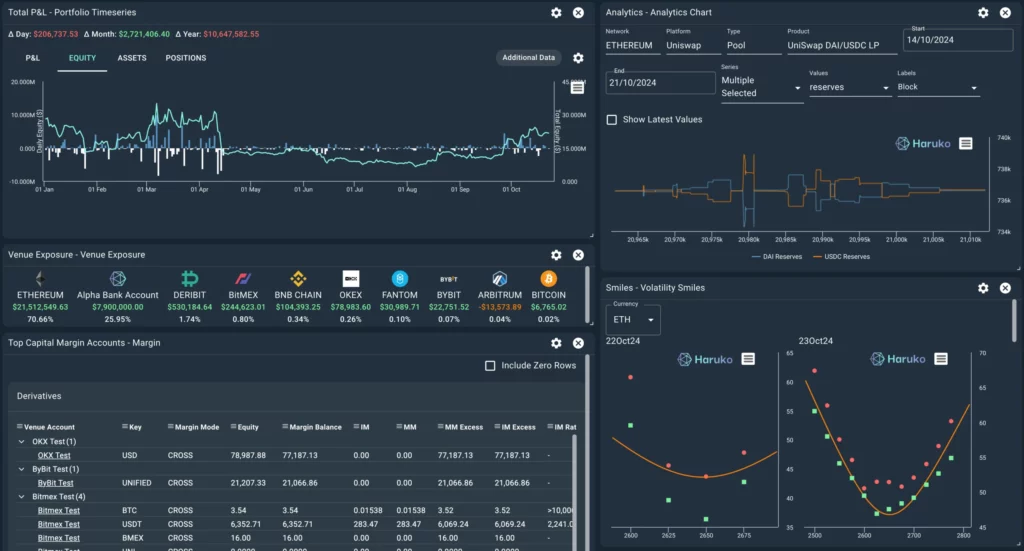
Professional investors now rely on integrated portfolio management platforms capable of consolidating fragmented blockchain activity into unified dashboards.
Advanced portfolio infrastructure enables users to:
- monitor asset allocation in real time;
- track performance across multiple chains and exchanges;
- automate portfolio rebalancing according to predefined rules;
- identify concentration risks before they become problematic;
- monitor liquidity availability and treasury utilization;
- receive intelligent alerts regarding significant market developments;
- visualize historical performance through comprehensive analytics.
Rather than replacing investment judgment, these tools provide the visibility necessary for informed decision-making in rapidly evolving markets.
Building a Smarter Digital Asset Infrastructure
The growing complexity of Web3 requires investment infrastructure capable of supporting more than simple asset storage. Modern platforms increasingly function as comprehensive operating environments where investors can monitor diversified portfolios, evaluate risk exposure, analyze liquidity, and optimize capital allocation from a single interface.
Integrated analytics, automated portfolio monitoring, intelligent rebalancing tools, and real-time treasury insights significantly reduce operational complexity while enabling investors to respond more effectively to changing market conditions. Instead of managing disconnected wallets, exchanges, and DeFi positions independently, users benefit from a unified ecosystem that provides complete visibility across their digital assets.
As institutional participation continues to expand, platforms offering secure infrastructure, advanced portfolio intelligence, and seamless capital management will become indispensable components of professional Web3 investing.
Conclusion
The evolution of cryptocurrency investing has fundamentally changed the definition of successful portfolio management. Superior performance no longer depends exclusively on identifying the next high-growth token or accurately timing market cycles. Instead, it reflects an investor’s ability to manage uncertainty through disciplined allocation, intelligent hedging, diversified exposure, continuous monitoring, and data-driven decision-making.
Volatility will remain an inherent characteristic of digital asset markets. Rather than attempting to eliminate it, sophisticated investors design portfolios capable of adapting to changing economic conditions while preserving long-term growth potential.
Crypto Portfolio Management 2.0 is therefore not simply about earning higher returns. It is about building resilient investment systems that combine technological innovation with sound financial discipline. In an increasingly interconnected Web3 economy, those systems will become the foundation upon which sustainable long-term wealth is created.