
The End of Manual Trading?
Financial markets have always rewarded those who could process information faster than everyone else. For decades, successful traders relied on technical indicators, chart patterns, macroeconomic analysis, and experience gained through thousands of hours in front of trading screens. While these methods remain valuable, the digital asset market has evolved into an environment where the volume, speed, and complexity of available information exceed the limits of human analysis.
The cryptocurrency market never closes. Every second, millions of transactions are processed across dozens of blockchain networks. Centralized exchanges generate enormous streams of order book updates, decentralized exchanges continuously rebalance liquidity pools, social media influences investor sentiment in real time, and on-chain activity reveals behavioral patterns that traditional financial markets simply cannot provide. The amount of data produced every day is measured in terabytes, making comprehensive manual analysis virtually impossible.
This is where artificial intelligence has become a transformative force. Rather than replacing traders, modern AI systems augment human decision-making by processing vast amounts of structured and unstructured data, identifying hidden relationships, recognizing emerging market conditions, and generating predictive insights that would be nearly impossible to discover through conventional analysis alone.
The future of crypto trading is no longer defined by who can read charts the fastest. It is increasingly determined by who can interpret the largest amount of relevant information in the shortest possible time.
Why Traditional Technical Analysis Has Reached Its Limits
Technical analysis has formed the foundation of trading strategies for generations. Support and resistance levels, moving averages, RSI, MACD, Bollinger Bands, Fibonacci retracements, and candlestick formations remain among the most widely used analytical tools across financial markets.
However, these indicators were designed during an era when market data consisted primarily of price and volume.
Today’s cryptocurrency ecosystem produces an entirely different information landscape.
A single trading decision may be influenced simultaneously by:
- on-chain transaction flows;
- whale wallet activity;
- derivatives positioning;
- exchange liquidity;
- stablecoin issuance;
- staking participation;
- decentralized finance liquidity migration;
- governance proposals;
- developer activity;
- regulatory announcements;
- macroeconomic indicators;
- social media sentiment;
- artificial intelligence trends.
No individual trader can evaluate all these variables simultaneously with consistent accuracy.
Artificial intelligence can.
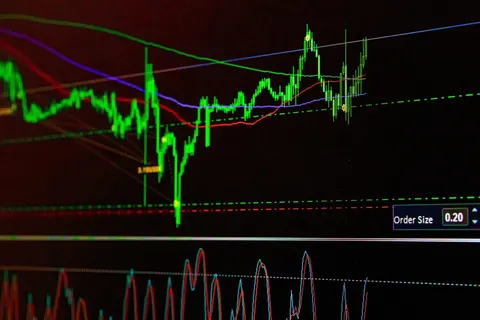
Big Data Has Changed the Nature of Market Analysis
Modern crypto markets generate several categories of information that continuously evolve in real time.
Market Data
Traditional trading information still matters.
Price action.
Trading volume.
Order books.
Funding rates.
Open interest.
Liquidation levels.
However, these represent only one layer of market intelligence.
On-Chain Data
Unlike traditional finance, blockchain provides transparent transaction history.
AI systems analyze:
- wallet behavior;
- token transfers;
- staking movements;
- liquidity changes;
- protocol interactions;
- bridge activity;
- smart contract usage.
These metrics often reveal structural shifts before they become visible through price action.
Alternative Data
Artificial intelligence also evaluates information beyond financial markets.
News articles.
Developer commits.
Community discussions.
Twitter activity.
Reddit conversations.
GitHub repositories.
Economic calendars.
Regulatory updates.
When combined, these data sources create a multidimensional picture of market behavior.
Neural Networks See Relationships Humans Cannot
Traditional trading strategies generally rely on predefined rules.
“If RSI falls below 30, consider buying.”
“If price crosses the 200-day moving average, expect trend continuation.”
Although useful, these rules assume that markets behave according to relatively stable historical relationships.
Neural networks operate differently.
Instead of following fixed instructions, they learn from enormous datasets by identifying statistical relationships between thousands of variables simultaneously.
For example, an AI model may discover that:
a rise in Ethereum gas fees…
combined with increasing stablecoin inflows…
alongside declining exchange reserves…
and growing GitHub activity…
historically preceded strong upward momentum within specific DeFi sectors.
No human trader would realistically recognize thousands of such multidimensional relationships across millions of historical observations.
Machine learning models continuously improve as additional information becomes available.
Pattern Recognition Beyond Human Perception
One of AI’s greatest strengths lies in pattern recognition.
Markets rarely repeat themselves exactly.
Instead, they produce variations of previous behaviors.
Artificial intelligence excels at identifying subtle similarities between current market conditions and historical events even when those similarities remain invisible to traditional chart analysis.
Examples include:
Volatility Regimes
AI detects transitions between low-volatility accumulation periods and explosive breakout environments.
Liquidity Migration
Machine learning models monitor how capital flows between blockchain ecosystems before significant market rotation occurs.
Behavioral Clustering
Investor groups often exhibit recurring behavioral patterns.
Retail enthusiasm.
Institutional accumulation.
Miner distribution.
Whale consolidation.
Algorithmic trading activity.
Artificial intelligence distinguishes these behavioral clusters with remarkable precision.
Predictive Models Continue Learning
Unlike static trading algorithms, machine learning models improve continuously.
Every market cycle generates additional training data.
Bull markets.
Bear markets.
Black Swan events.
Liquidity crises.
Protocol failures.
Macroeconomic shocks.
Each event becomes another educational example that refines predictive accuracy.
Modern AI systems adapt dynamically instead of relying exclusively on assumptions developed years earlier.
This continuous learning process allows models to remain relevant despite rapidly changing market conditions.
Natural Language Processing Has Become a Trading Tool
Markets respond to information long before analysts publish formal reports.
Artificial intelligence increasingly relies on Natural Language Processing (NLP) to interpret enormous quantities of written communication.
These systems evaluate:
news headlines;
central bank speeches;
earnings reports;
government announcements;
social media conversations;
developer documentation;
research publications.
Rather than simply identifying positive or negative sentiment, advanced language models understand context, probability, and relationships between events.
This capability allows AI systems to react faster than manual analysis whenever new information enters the market.
AI Does Not Eliminate Risk
One of the most common misconceptions surrounding artificial intelligence is the belief that predictive models guarantee profitable trading.
They do not.
Markets remain inherently uncertain.
Unexpected geopolitical developments, exchange failures, regulatory intervention, technological vulnerabilities, or extreme macroeconomic events can invalidate even highly sophisticated predictions.
Artificial intelligence improves probability rather than certainty.
Professional traders therefore use AI as a decision-support system rather than an autonomous replacement for human judgment.
Risk management remains essential.
Position sizing.
Diversification.
Capital allocation.
Liquidity management.
Stop-loss discipline.
These principles remain unchanged regardless of technological advancement.
Human Intelligence and Artificial Intelligence Work Best Together
The most successful trading organizations rarely rely exclusively on human intuition or complete automation.
Instead, they combine both strengths.
Artificial intelligence processes enormous datasets.
Humans evaluate strategic context.
AI identifies opportunities.
Humans determine acceptable risk.
Algorithms execute calculations instantly.
Experienced investors interpret broader market narratives.
This collaborative approach consistently produces stronger long-term results than either methodology operating independently.
Technology enhances expertise rather than replacing it.
The Infrastructure Behind AI-Powered Trading
Building effective AI trading systems requires considerably more than sophisticated machine learning models. The quality of predictions depends directly on the quality of the underlying infrastructure responsible for collecting, processing, and interpreting market data in real time.
Modern crypto trading platforms increasingly integrate multiple analytical layers into unified ecosystems that combine live market feeds, on-chain intelligence, sentiment analysis, portfolio monitoring, and predictive modeling. Instead of forcing traders to manually compare dozens of disconnected dashboards, advanced platforms consolidate critical information into actionable insights supported by artificial intelligence.
Integrated AI assistants can help identify emerging trends, monitor unusual market activity, evaluate portfolio exposure, and generate data-driven trading signals while allowing users to maintain complete control over final investment decisions. This combination of automation and transparency enables both professional investors and active traders to respond more efficiently to rapidly changing market conditions.
As blockchain ecosystems continue expanding, platforms capable of transforming overwhelming quantities of raw data into clear, meaningful intelligence will become increasingly valuable across the entire digital asset industry.
The Future of AI in Cryptocurrency Markets
Artificial intelligence is still in the early stages of its integration into decentralized finance.
Future developments are expected to include:
fully autonomous portfolio optimization;
adaptive trading algorithms;
cross-chain liquidity forecasting;
predictive smart contract analytics;
AI-powered treasury management;
real-time risk assessment;
personalized investment assistants.
Large language models will increasingly interact directly with blockchain infrastructure, helping investors understand complex protocols, evaluate tokenomics, compare governance proposals, and optimize capital allocation through conversational interfaces.
Rather than replacing financial professionals, AI will increasingly function as an intelligent analytical layer supporting every stage of investment decision-making.
Conclusion
The cryptocurrency market has evolved beyond the capabilities of purely manual analysis. The enormous volume of market data, blockchain activity, macroeconomic information, and investor behavior now demands technologies capable of processing millions of variables simultaneously.
Artificial intelligence provides exactly that capability.
Through neural networks, machine learning, natural language processing, and real-time data analysis, AI identifies relationships, detects emerging patterns, and generates predictive insights that traditional analytical methods often overlook. While these technologies cannot eliminate uncertainty or guarantee profitable outcomes, they significantly improve the speed, depth, and quality of market intelligence available to investors.
The future of crypto trading will not belong exclusively to artificial intelligence, nor solely to experienced human traders. It will belong to those who successfully combine computational power with strategic thinking, disciplined risk management, and a deep understanding of market structure.
In an increasingly data-driven financial world, information is no longer the greatest competitive advantage. The ability to interpret that information intelligently has become the true currency of successful investing.