
Passive Income Is No Longer Enough
For many investors entering the cryptocurrency market, staking was initially perceived as a simple alternative to traditional savings accounts. Instead of leaving digital assets idle in a wallet, holders could lock their tokens to help secure a blockchain network while earning rewards in return. This model quickly became one of the cornerstones of Proof-of-Stake (PoS) ecosystems, attracting billions of dollars in capital across networks such as Ethereum, Solana, Cosmos, Avalanche, and many others.
However, as decentralized finance matured, investors began to recognize a fundamental limitation. While staking generated passive income, it also reduced capital flexibility. Assets locked within validator networks could not simultaneously be deployed in lending markets, liquidity pools, trading strategies, or other yield-generating opportunities. Capital security came at the expense of capital efficiency.
The emergence of Liquid Staking and, more recently, Restaking, has fundamentally changed this equation. These innovations allow investors to continue securing blockchain networks while maintaining access to liquidity and expanding the productive use of their assets. Rather than choosing between security and flexibility, modern staking infrastructure enables capital to perform multiple functions simultaneously.
This evolution represents one of the most important developments in decentralized finance because it transforms staking from a passive investment mechanism into a dynamic component of broader capital management strategies.
Understanding Traditional Staking
Before exploring liquid staking and restaking, it is essential to understand the mechanics of conventional staking.
In Proof-of-Stake networks, validators are responsible for confirming transactions and maintaining consensus across the blockchain. To participate, validators commit a specified amount of cryptocurrency as collateral. This economic stake incentivizes honest behavior because malicious actions can result in financial penalties through mechanisms commonly known as slashing.
Individual investors who do not operate validator infrastructure typically delegate their assets to professional validators. In return, they receive a share of the staking rewards generated by the network.
The advantages of traditional staking are clear:
- predictable passive income;
- contribution to blockchain security;
- participation in network governance;
- long-term alignment with ecosystem growth.
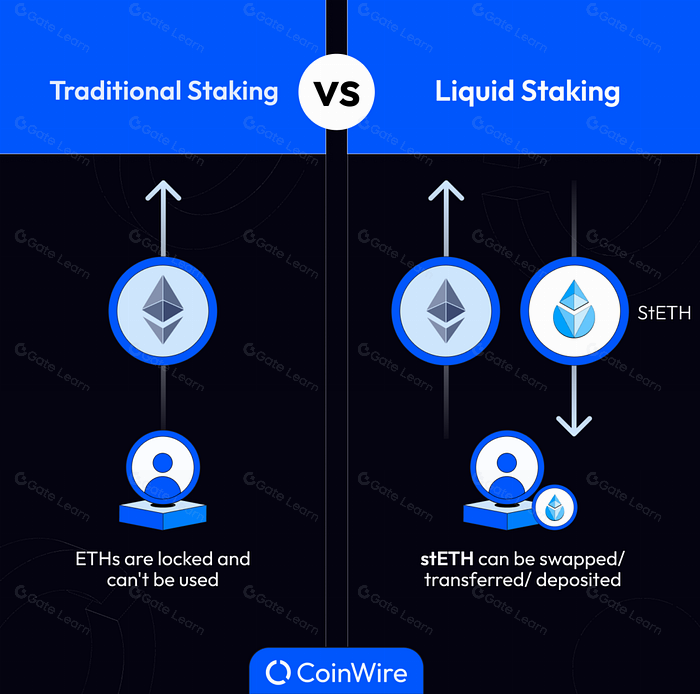
Despite these benefits, conventional staking introduces one significant drawback: illiquidity.
During staking periods, assets often remain inaccessible for trading, lending, or portfolio reallocation. Some networks also impose lengthy unbonding periods before withdrawals become available, limiting an investor’s ability to respond quickly to changing market conditions.
The Opportunity Cost of Locked Capital
Institutional investors rarely evaluate investments based solely on return percentages. They also consider capital efficiency—the extent to which every dollar or token continues generating value across multiple strategies.
Locked assets represent opportunity cost.
Imagine an investor staking Ethereum during a period when attractive lending opportunities emerge within decentralized finance. Accessing those opportunities may require unstaking assets, potentially triggering waiting periods that prevent immediate participation.
Similarly, sudden market volatility may create attractive buying opportunities, but capital committed to traditional staking cannot easily be reallocated.
These limitations inspired one of DeFi’s most important innovations: Liquid Staking.
Liquid Staking: Unlocking Capital Without Leaving the Network
Liquid Staking fundamentally changes the staking experience by separating network participation from asset usability.
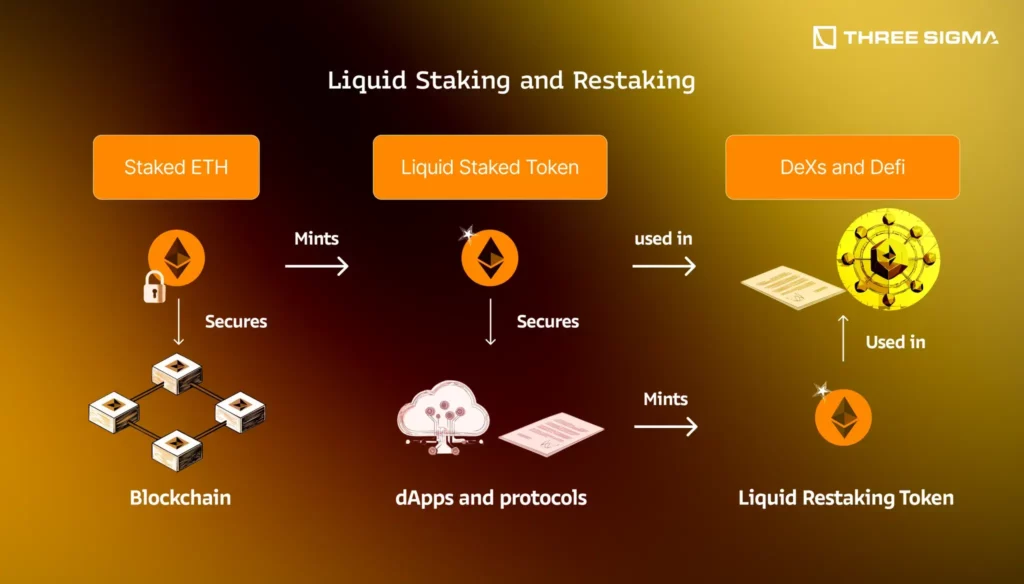
Instead of permanently locking assets, investors deposit their tokens into specialized liquid staking protocols. Those protocols stake the underlying assets on behalf of users while simultaneously issuing liquid staking tokens (LSTs) representing the deposited collateral.
For example, staked ETH may generate a liquid derivative token that remains fully transferable and compatible with decentralized finance applications.
This seemingly simple innovation has profound implications.
The original assets continue earning staking rewards.
The liquid staking token remains available for:
- lending protocols;
- decentralized exchanges;
- liquidity pools;
- collateralized borrowing;
- structured yield strategies;
- automated portfolio management.
Capital effectively begins working in multiple environments simultaneously.
Instead of sacrificing liquidity for yield, investors maintain flexibility while continuing to support blockchain security.
Why Liquid Staking Became a Cornerstone of DeFi
The rapid adoption of liquid staking reflects its ability to solve several long-standing inefficiencies within decentralized finance.
Improved Capital Efficiency
Idle assets become productive assets capable of participating in multiple financial strategies simultaneously.
Enhanced Market Liquidity
Liquid staking tokens circulate freely throughout DeFi ecosystems, increasing available liquidity across decentralized applications.
Lower Barriers to Participation
Users no longer need to operate validator infrastructure or maintain complex staking configurations.
Portfolio Flexibility
Investors retain the ability to adjust allocations, manage collateral, and respond to market developments without abandoning staking rewards.
As decentralized finance increasingly emphasizes efficient capital utilization, liquid staking has become an essential building block rather than a specialized niche product.
Restaking: The Next Evolution of Blockchain Security
While liquid staking solved the liquidity problem, another question soon emerged.
Could already staked assets contribute to securing additional decentralized services without requiring entirely new collateral?
Restaking answers this question.
Rather than limiting staked assets to securing a single blockchain, restaking protocols enable existing collateral to provide cryptoeconomic security for multiple decentralized applications, middleware services, oracle networks, data availability layers, and other blockchain infrastructure.
In practical terms, the same economic stake can now contribute to protecting several interconnected systems simultaneously.
This creates a more efficient allocation of security across the broader Web3 ecosystem.
Instead of each protocol building entirely separate validator networks and attracting independent collateral, emerging decentralized services can leverage existing staking infrastructure.
How Restaking Expands Yield Opportunities
One of the primary attractions of restaking is its potential to generate additional rewards beyond standard staking income.
Participants may receive:
- traditional staking rewards;
- protocol incentives;
- governance tokens;
- security compensation from additional networks;
- ecosystem-specific reward distributions.
For investors, this creates opportunities to improve capital productivity without increasing initial principal allocation.
However, these additional returns should always be evaluated within the context of additional risk.
Higher yield frequently reflects increased complexity rather than free economic value.
Understanding where those rewards originate remains essential before participating.
The Risks Investors Must Understand
Although staking innovations create significant opportunities, they also introduce new categories of risk that deserve careful consideration.
Smart Contract Risk
Liquid staking protocols depend upon complex smart contracts that may contain vulnerabilities despite extensive auditing.
Independent security reviews, formal verification, and transparent development practices significantly reduce—but cannot entirely eliminate—technical risk.
Slashing Risk
Validators engaging in malicious or negligent behavior may incur financial penalties that affect delegated assets.
Selecting reputable validator infrastructure remains an important component of risk management.
Liquidity Risk
Although liquid staking tokens are designed to remain tradable, market conditions may occasionally cause temporary deviations between derivative token prices and underlying assets.
Investors requiring immediate liquidity should understand these potential pricing dynamics.
Restaking Complexity
Restaking introduces additional protocol dependencies.
Assets become indirectly connected to multiple decentralized services whose operational risks may influence overall portfolio performance.
Higher yields often correspond to greater interconnectedness within the blockchain ecosystem.
Capital Allocation in a Multi-Yield Environment
The emergence of liquid staking and restaking requires investors to rethink traditional portfolio construction.
Instead of viewing assets as either invested or idle, modern DeFi increasingly enables capital to fulfill multiple simultaneous roles.
A single digital asset may:
- secure a blockchain;
- generate staking rewards;
- function as collateral;
- provide liquidity;
- participate in lending markets;
- contribute to decentralized infrastructure security.
This layered productivity represents one of decentralized finance’s greatest competitive advantages over many traditional financial systems.
Rather than replacing existing investment principles, DeFi expands the number of productive pathways available to every asset.
Institutional Interest Continues to Grow
Institutional investors have become increasingly interested in staking infrastructure because it aligns well with long-term capital management objectives.
Large asset managers prioritize:
- predictable income generation;
- transparent risk frameworks;
- diversified revenue streams;
- operational efficiency;
- scalable infrastructure.
Liquid staking addresses many of these priorities by preserving liquidity while maintaining blockchain participation.
Restaking further enhances institutional interest by improving capital utilization across expanding Web3 infrastructure.
As regulatory clarity continues improving worldwide, staking services are expected to become an increasingly important component of institutional digital asset portfolios.
Choosing the Right Staking Infrastructure
As staking ecosystems become more sophisticated, selecting the right platform is no longer simply a matter of comparing headline APY figures. Investors should evaluate the broader infrastructure supporting their assets, including validator reliability, security architecture, liquidity management, protocol transparency, and ongoing ecosystem development.
A well-designed Web3 platform should provide users with clear visibility into staking performance, flexible liquidity options, integrated portfolio management, and transparent reward calculations. Access to liquid staking solutions, automated yield optimization, and carefully managed restaking opportunities enables investors to maximize capital efficiency without sacrificing operational control over their assets.
Equally important is a strong commitment to security. Independent smart contract audits, continuous protocol monitoring, secure custody architecture, and robust risk management practices help ensure that passive income strategies remain sustainable over the long term rather than exposing investors to unnecessary vulnerabilities.
The Future of Yield Generation
The concept of passive income within cryptocurrency is evolving rapidly.
Traditional staking represented the first stage.
Liquid staking introduced flexibility.
Restaking expanded network security and capital productivity.
The next generation of decentralized finance will likely continue integrating staking with artificial intelligence, automated portfolio optimization, tokenized real-world assets, cross-chain liquidity management, and institutional treasury operations.
Yield generation will become increasingly adaptive rather than static.
Instead of selecting one protocol and waiting for rewards, investors will interact with intelligent infrastructure capable of dynamically optimizing capital allocation across multiple blockchain ecosystems.
The distinction between staking, lending, liquidity provision, and treasury management will gradually become less pronounced as decentralized financial infrastructure grows more interconnected.
Conclusion
Staking has evolved far beyond its original purpose of securing blockchain networks while generating passive rewards. Today, liquid staking and restaking represent a new philosophy of capital management in which assets are expected to remain continuously productive without sacrificing flexibility or accessibility.
By enabling investors to maintain liquidity, participate in decentralized finance, support blockchain security, and access multiple sources of yield simultaneously, these innovations dramatically improve capital efficiency across the Web3 economy.
Nevertheless, greater opportunity always demands greater understanding. Smart contract security, validator reliability, liquidity conditions, and protocol architecture all play essential roles in determining the long-term success of staking strategies.
For both retail and institutional investors, the future of staking is no longer simply about earning rewards. It is about building a resilient, intelligent, and highly efficient digital asset portfolio capable of adapting to an increasingly sophisticated decentralized financial ecosystem.