
Trading Has Become a Software Problem
The cryptocurrency market is unlike any traditional financial market. It never closes, it operates across hundreds of exchanges simultaneously, and it reacts to news, on-chain activity, macroeconomic events, and investor sentiment within seconds. Human traders, regardless of experience, simply cannot monitor every market twenty-four hours a day while making perfectly rational decisions under constantly changing conditions.
This reality has transformed algorithmic trading from a niche discipline used by quantitative hedge funds into a fundamental component of modern crypto investing. Today, trading bots execute millions of transactions daily, providing liquidity, identifying arbitrage opportunities, managing portfolios, and implementing sophisticated trading strategies with a level of speed and consistency that manual trading cannot match.
Yet despite their growing popularity, many investors misunderstand what trading bots actually are. A bot is not a guaranteed profit machine, nor is it a shortcut to effortless wealth. At its core, a trading bot is nothing more than a set of predefined rules executed automatically according to market conditions. Its success depends entirely on the quality of the strategy behind it, the reliability of its infrastructure, and the discipline with which it manages risk.
Building an effective algorithmic trading system therefore requires far more than writing code. It demands a deep understanding of market structure, execution mechanics, data quality, and continuous optimization.
What Is a Trading Bot?
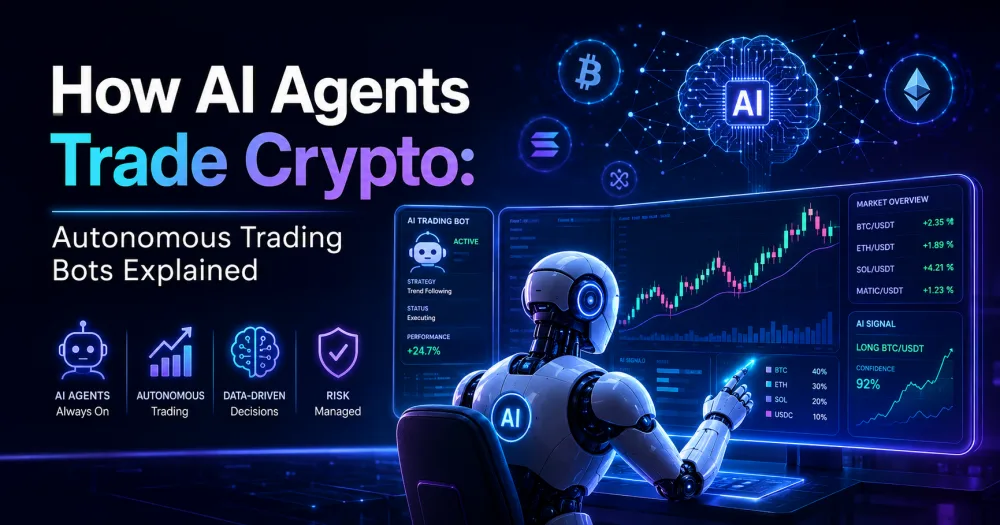
A crypto trading bot is an automated software system that interacts with exchanges through APIs, continuously monitoring market conditions and executing predefined trading instructions without manual intervention.
Unlike discretionary traders, bots do not experience fear, greed, hesitation, or emotional bias. Every decision follows a logical framework established before the strategy begins operating.
A typical trading bot performs several tasks simultaneously:
- collects live market data;
- evaluates predefined trading conditions;
- calculates risk exposure;
- places buy or sell orders;
- manages open positions;
- adjusts stop-loss and take-profit levels;
- records trading history for later analysis.
Because these operations occur automatically, bots can react to market changes within milliseconds rather than seconds or minutes.
However, speed alone does not create profitability. Intelligent decision-making remains the most important factor.
Every Trading Bot Starts With a Strategy
Many beginners focus immediately on programming languages or exchange APIs, overlooking the more important question:
“What should the bot actually do?”
A trading algorithm simply automates an investment strategy that already exists.
Before writing a single line of code, traders should define:
market conditions for entry;
conditions for exiting positions;
acceptable risk per trade;
portfolio allocation rules;
position sizing methodology;
maximum drawdown tolerance;
emergency shutdown conditions.
Without clearly defined rules, automation merely accelerates poor decision-making.
The strategy always comes before the software.
Understanding Grid Trading Bots
Grid trading has become one of the most widely used automated strategies within cryptocurrency markets because it performs particularly well during periods of sideways price movement.
A grid bot divides a selected price range into multiple predefined levels.
Whenever price declines, the bot automatically buys.
Whenever price rises, the bot sells.
Over time, the strategy attempts to profit from repeated market oscillations rather than predicting long-term direction.
Grid trading offers several advantages.
It removes emotional decision-making.
It continuously participates in market volatility.
It requires relatively little manual supervision.
However, grid strategies also possess important limitations.
Strong trending markets may generate prolonged unrealized losses if prices continue moving beyond the predefined trading range.
Consequently, successful grid trading depends heavily on selecting appropriate market environments rather than assuming universal profitability.
Trend-Following Algorithms
Whereas grid trading performs best during ranging markets, trend-following algorithms attempt to identify sustained directional momentum.
These strategies frequently combine indicators such as:
moving averages;
volume analysis;
trend strength indicators;
volatility measurements;
breakout confirmation.
Rather than buying every price decline, trend-following systems seek confirmation that a meaningful directional movement has begun.
Once established, the algorithm attempts to remain invested until objective evidence suggests the trend has weakened.
Although trend strategies often capture large market movements, they may also generate multiple false signals during periods of consolidation.
No strategy performs equally well under every market condition.
Arbitrage Bots: Exploiting Market Inefficiencies
Cryptocurrency markets remain fragmented across numerous centralized and decentralized exchanges.
Because prices rarely remain perfectly synchronized, temporary differences occasionally appear between trading venues.
Arbitrage bots exploit these discrepancies by simultaneously purchasing an asset on one exchange while selling it elsewhere at a higher price.
Several forms of arbitrage exist.
Cross-Exchange Arbitrage
The same asset trades at different prices across multiple exchanges.
Triangular Arbitrage
Price inefficiencies emerge between three trading pairs within the same exchange.
Cross-Chain Arbitrage
Liquidity differences develop between blockchain ecosystems connected through bridging infrastructure.
Although arbitrage appears low-risk in theory, successful implementation requires extremely fast execution, reliable infrastructure, and careful consideration of transaction fees, withdrawal times, and network congestion.
High-Frequency Trading in Crypto Markets
High-Frequency Trading (HFT) represents one of the most technologically demanding forms of algorithmic trading.
These systems execute enormous numbers of transactions within extremely short time intervals, often measuring execution speed in microseconds.
HFT strategies rely upon:
ultra-low latency infrastructure;
direct exchange connectivity;
advanced order book analysis;
real-time market microstructure modeling.
For most retail investors, true high-frequency trading remains impractical because competing successfully requires substantial technological resources and specialized infrastructure.
Nevertheless, many concepts developed within HFT—including execution optimization and latency reduction—have gradually influenced more accessible algorithmic trading systems.
Risk Management Is More Important Than Entry Signals
Many trading discussions focus almost exclusively on identifying perfect entry points.
Professional algorithmic traders understand that long-term success depends far more on risk management than signal generation.
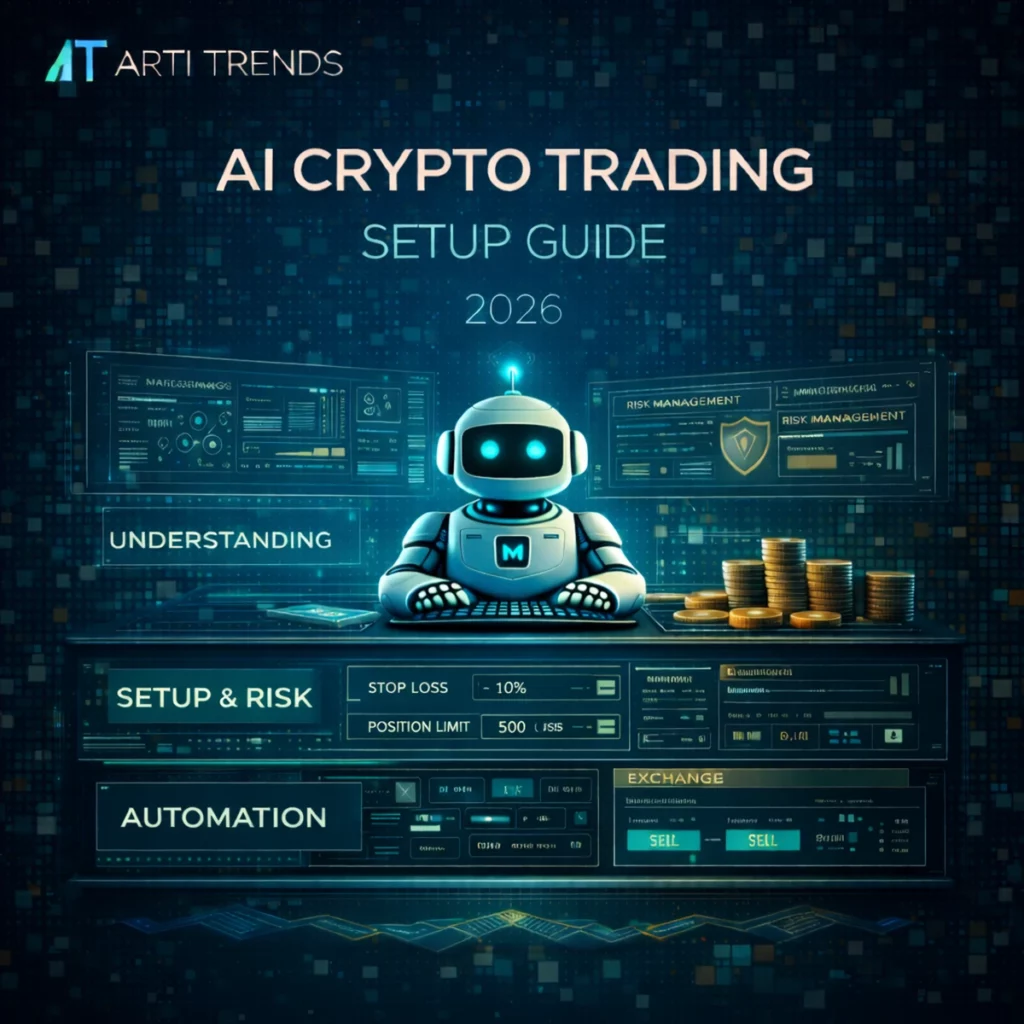
An effective trading bot should always incorporate:
Position Sizing
No individual trade should expose excessive portfolio capital regardless of confidence level.
Stop-Loss Logic
Automated exit conditions prevent catastrophic losses during unexpected market movements.
Portfolio Exposure Limits
The system should monitor overall exposure across correlated assets rather than evaluating trades independently.
Maximum Daily Drawdown
Many institutional algorithms automatically suspend trading after predetermined loss thresholds are reached.
These protective mechanisms often determine whether an algorithm survives difficult market conditions.
Common Coding Mistakes That Destroy Trading Performance
Even well-designed strategies can fail because of implementation errors.
Some of the most common programming mistakes include:
Overfitting Historical Data
Algorithms become excessively optimized for past market conditions while performing poorly in live trading.
Ignoring Transaction Costs
Backtests frequently overlook commissions, spreads, funding rates, and slippage.
Poor Exception Handling
Unexpected API failures, exchange maintenance, or network interruptions may produce unintended trades.
Inadequate Data Validation
Incorrect market data can trigger false trading signals.
Insufficient Stress Testing
Algorithms should be evaluated under both favorable and unfavorable market environments before deployment.
Successful algorithmic trading depends as much upon engineering discipline as financial expertise.
Backtesting Is Only the Beginning
Backtesting allows traders to evaluate historical strategy performance before risking real capital.
Although indispensable, historical simulation possesses important limitations.
Markets evolve continuously.
Liquidity changes.
Trading participants adapt.
Regulations shift.
Technological infrastructure improves.
A profitable historical strategy may deteriorate rapidly under different market conditions.
Professional development therefore follows several stages:
historical backtesting;
paper trading;
limited live deployment;
performance monitoring;
continuous optimization.
Algorithmic strategies require ongoing maintenance rather than one-time development.
APIs: The Bridge Between Strategy and Execution
Every trading bot ultimately depends on secure and reliable communication with exchanges. This interaction is made possible through Application Programming Interfaces (APIs), which allow automated systems to retrieve market data, monitor account balances, place orders, and manage positions without manual intervention.
A well-designed trading platform simplifies this process by offering secure API integration, comprehensive documentation, flexible authentication methods, and reliable execution infrastructure. Instead of requiring traders to build every component from scratch, modern platforms increasingly provide ready-to-deploy algorithmic frameworks that enable users to launch, customize, and monitor automated strategies with minimal technical complexity.
Integrated dashboards further enhance operational efficiency by allowing users to supervise multiple bots, analyze performance metrics, adjust risk parameters, and monitor live trading activity from a single interface. Combined with robust infrastructure and high system availability, these capabilities significantly reduce the operational burden associated with algorithmic trading while enabling investors to focus on strategy development rather than technical maintenance.
The Future of Algorithmic Trading
Artificial intelligence, decentralized finance, and blockchain interoperability are rapidly expanding what trading bots can accomplish.
Future algorithmic systems are expected to:
adapt strategies automatically using machine learning;
optimize execution across multiple blockchain networks;
manage diversified portfolios autonomously;
incorporate on-chain analytics into trading decisions;
evaluate macroeconomic events through natural language processing;
coordinate capital allocation across centralized and decentralized exchanges simultaneously.
The distinction between portfolio management software, trading algorithms, and artificial intelligence will continue to blur as financial technology becomes increasingly integrated.
Tomorrow’s trading bots will likely function less as simple execution engines and more as intelligent financial assistants capable of continuous market interpretation.
Conclusion
Algorithmic trading has become an essential component of the cryptocurrency ecosystem because it addresses one of the market’s greatest challenges: the inability of humans to process enormous quantities of information continuously and without emotional bias.
From straightforward grid bots to sophisticated arbitrage systems and advanced quantitative strategies, automation enables investors to execute predefined rules with consistency, discipline, and speed. Yet successful algorithmic trading is never the product of software alone. It emerges from the combination of sound strategy, rigorous risk management, reliable infrastructure, thorough testing, and continuous optimization.
As cryptocurrency markets become more competitive and data-intensive, the advantage will increasingly belong to investors who understand that automation is not a substitute for intelligent decision-making—it is a tool that amplifies it. The most successful trading systems of the future will not simply execute orders faster; they will integrate data, analytics, artificial intelligence, and disciplined portfolio management into a unified framework capable of adapting to an ever-evolving financial landscape.